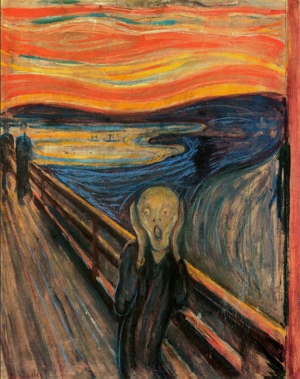
Norway boasts a number of famous people that even I recognize. And while it’s true that most of those are filed under Explorer’s (more about them later) old Edvard is from the field of art. Although he lived from 1863 through to 1944 when he passed away here in Oslo, he was remarkable prescient. It is little known that his most well know work, The Scream, is based directly on my experience this morning on arrival in Oslo on BA762. While I arrived safely, my bicycle is still touring the baggage retrieval system at Heathrow leading to the emotion so vividly captured back in 1893 by Eddie.
I had suspected that the 90 minute turn around transit was going to be tough, for humans and baggage. Luckily I sped through and even had time for a breakfast snack before boarding and managed to score 100% for humans. The baggage system at Heathrow meanwhile could only manage a paltry 50% score. At time of writing I am told that the bike is on the 4pm flight and should be delivered to me sometime after 6pm. Thankfully the ride starts only Sunday. If it had started tomorrow, the anxiety level would be off the charts.
Back to the explorers. The most famous would probably be Roald Amundsen. But seeing as he, er, famously kicked Scott’s butt in the race to the South pole, it’s probably not fair to dwell on that given Queen Elizabeth’s jubilee celebrations are not yet cold. Amundson was the protégé (add slanty accents wherever you like if you don’t like mine) of Fridtjof Nansen who would have been more famous if the English speaking world could sort out the pronunciation of his first name! ˈfrɪd.tʃɒf ˈnænsən/ frid-choff nan-sənif you were wondering.
Most famous explorers are famous for a hare brained scheme that comes off. Explorers whose hare brained schemes don’t come off are normally less famous and more often than not, deceased. Nansen’s idea was to be first to reach the north pole by drifting around in a boat trapped in the pack ice. So he purpose built the Fram and set sail. The plan basically worked except that the rate of northerly drift slowed in the higher latitudes (eventually only 1mph). Undeterred, when the ice bound vessel passed 84d North he struck out on foot. This after about 18 months of drifting in the ice! Eventually they turned back just north of 86d N when they realised that they were marching against a southerly drift and would not make it to the pole and and back before their food ran out or they did. A new record nonetheless, but not the prize he had hoped for. Apparently he coined the popular South African phrase “if you catch my drift” during the return march.
In the map below you can see the tracks of the various players in the saga. By the way, The Fram did eventually drift free of the pack ice and also made it back. She is on exhibit here in Olso. Nansen is not.
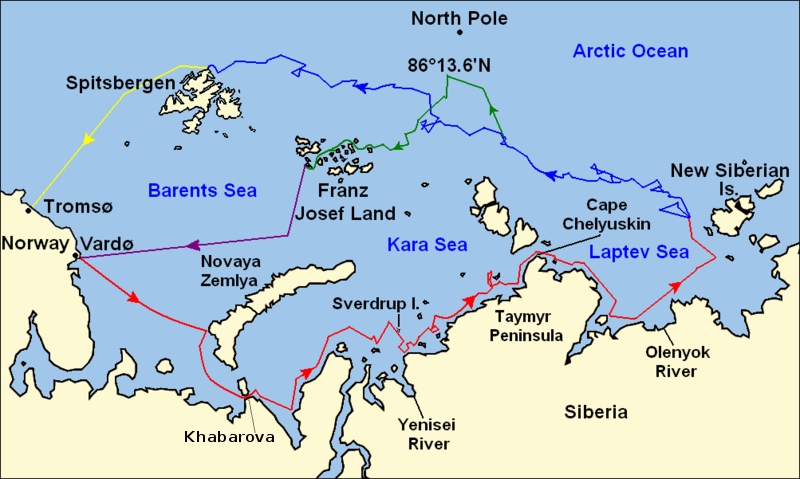
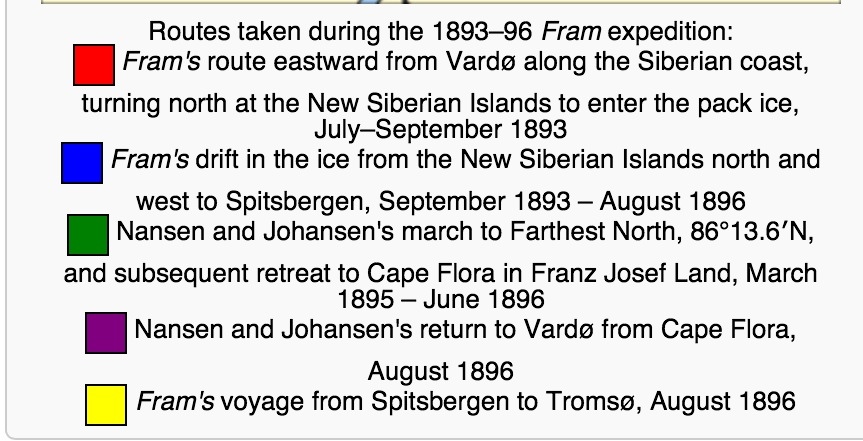
The journey back was itself an adventure of note – they had always planned to return not to the ship but to the most northerly inhabited land – Spitzbergen. After holing up for the winter on the most northerly bit of land – Franz Joseph Land, which is not exactly verdant anyway – they were “rescued” by another explorer, Frederick Jackson and survived to claim the record. Pictured below is there fortuitous meeting.

Not unusually for the time, exploration was one of many activities that Nansen was involved in being also a scientist (exploration is a good fit) and a humanitarian (not useful when exploring areas where no one had gone before). It was for his efforts in assisting displaced WW1 veterans that he was awarded the Nobel Peace Price in 1922.
Another famous Norwegian explorer is Thor Heyerdahl who starting that whole Kontiki drifting around Europe thing. Or was that the Pacific? Close enough.
There are some famous Norwegian cyclists, but more about them tomorrow.
 Eleven Wise Monkeys